Part 3: What the CEAL looks like

From CDP to CEAL · Part 3 of 8
If agents become the interface, the architecture underneath has to change. Here is the shape it's converging on.
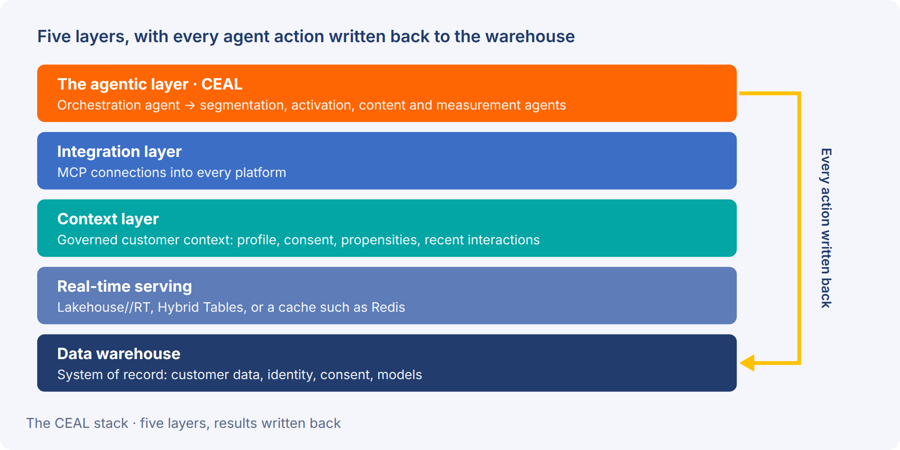
In Part 2, I argued that the CDP never delivered because it was one more interface. So what replaces it? The architecture is settling into a simple stack: the data warehouse, then a context layer, then an integration layer built on MCP, then straight onto the agentic layer.
The warehouse as system of record
Customer data, identity resolution and model training sit in Databricks, Snowflake or BigQuery, and tools read the data where it lives rather than copying it. Zero-copy is now the norm: Salesforce extended Data 360 zero-copy to AWS and BigQuery, and Snowflake added zero-copy integrations with SAP and Salesforce, with Workday in private preview.
Real-time serving: the gap still to close
An in-session decision needs data in milliseconds. Today most enterprises run a hybrid: the warehouse for batch, plus a cache such as Redis or a CDP's own real-time store. Real Story Group calls it "hybrid composable". The warehouse vendors are closing in. Databricks claims under 100ms at 12,000 queries a second for Lakehouse//RT, in beta since June, and Snowflake Hybrid Tables offer lookups in double-digit milliseconds.
The context layer
Agents shouldn't query raw tables. They need a governed view of the customer: profile, consent, propensities and recent interactions. Gartner made AI context platforms a top trend for 2027, predicting they can raise agent accuracy by up to 80% and cut costs by up to 60%. Tealium has launched a Context API with a managed MCP server.
The integration layer
MCP has become the common connector between agents and platforms. It is now governed by the Linux Foundation's Agentic AI Foundation, so no single vendor owns it.
The CEAL itself
An orchestration agent takes the marketer's brief and plans the work. Segmentation agents connect directly to the data warehouse to build audience segments and access the attributes required for personalisation, as well as identity and consent for activation. Activation agents carry it out across email, app, SMS, paid media and web. Content agents draw on the DAM and creative tools. Measurement agents report back and write the results to the warehouse. The pieces are already shipping: Braze's Operator now builds whole journeys from a plain-language brief, and Salesforce's multi-agent orchestration is generally available.
What brands will compete on
When agents are the interface, advantage moves to what only you own: the quality of your data, your context layer, your identity and consent model, and your machine learning models. Then: how many agents you connect with, and how well.
About this series. From CDP to CEAL is an eight-part series by Kristina Kalpokaite, Head of MarTech at Loop Horizon, on how AI agents will replace the interfaces of marketing technology. Start with Part 1, The CEAL is coming.